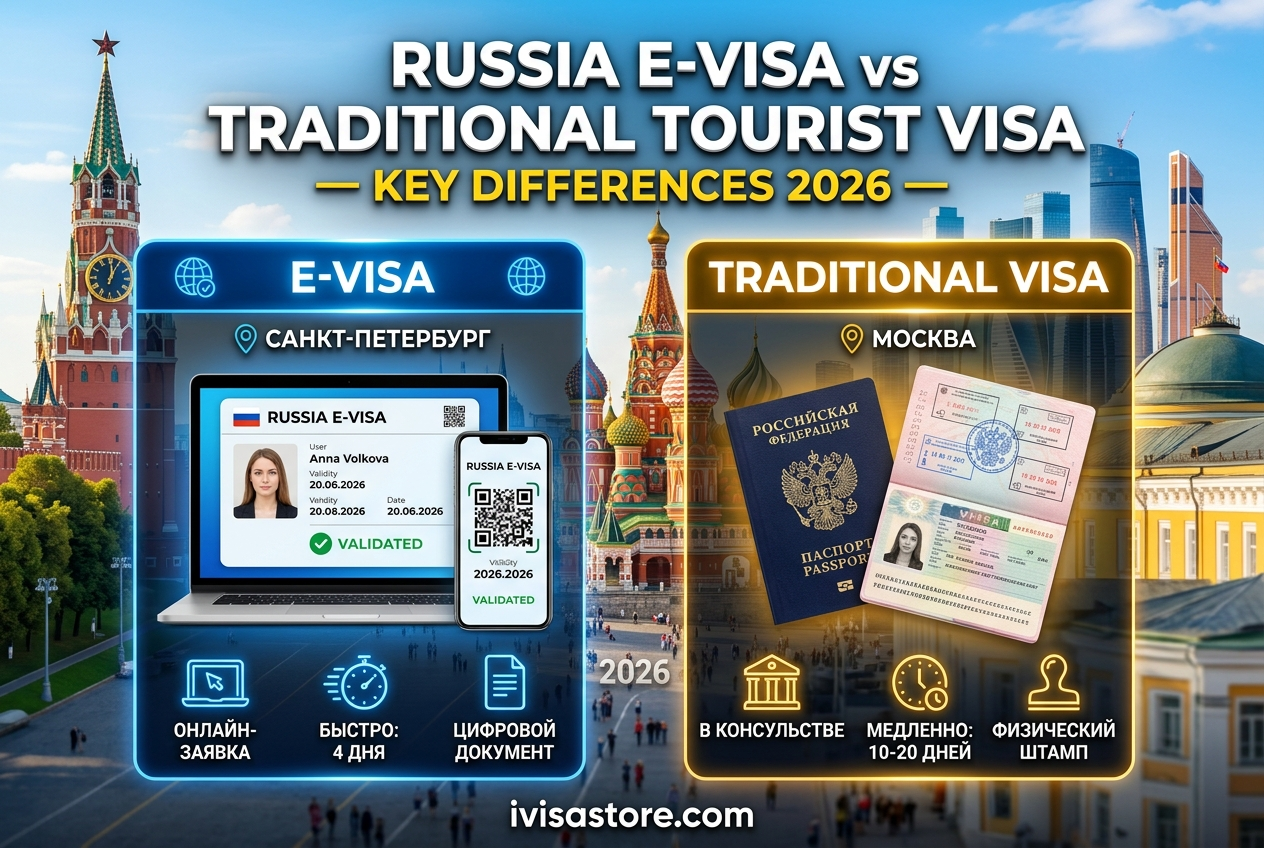
Russia E-Visa vs Traditional
Tourist Visa — Key Differences 2026
Russia offers two completely different ways to get a tourist visa — the fast online e-visa and the traditional consular tourist visa. This guide compares them across every factor that matters so you can choose the right one for your trip in under 5 minutes.
Contents
- 1 Quick answer — which one is for you?
- 2 Eligibility — who can get each type?
- 3 Full comparison table
- 4 Difference 1 — Eligibility
- 5 Difference 2 — Process & documents
- 6 Difference 3 — Cost
- 7 Difference 4 — Stay length & entries
- 8 Difference 5 — Entry points
- 9 Difference 6 — Belarus
- 10 Which visa for which scenario?
- 11 FAQ
Russia introduced the unified electronic visa (e-visa) system in 2023, giving eligible travellers a fast online alternative to the traditional consular tourist visa. Both are valid ways to enter Russia — but they work very differently and suit different types of trips. Here is everything you need to know to choose correctly.
1. Quick answer — which one is for you?
Get the e-visa if: you are from one of the 64 eligible countries, your trip is 30 days or less, you want the fastest possible process with no consulate visit, and you are entering through a major airport or approved border crossing.
Get the traditional tourist visa if: your country is not on the e-visa list (UK, US, Canada, Australia), you want to stay longer than 30 days, you need double or multiple entry, you want to also visit Belarus on the same trip, or you are crossing a land border that is not on the e-visa approved list.
2. Eligibility — who can get each type?
✓ E-visa eligible countries (selected)
- All EU / Schengen countries
- France, Germany, Italy, Spain
- China, Japan, South Korea
- India, Indonesia, Vietnam
- Turkey, Saudi Arabia, UAE
- Mexico, Brazil, Argentina
- Singapore, Malaysia, Philippines
- Iran, Kuwait, Oman, Bahrain
✗ E-visa NOT available for
- United States
- United Kingdom
- Canada
- Australia
- New Zealand
- Pakistan, Bangladesh
- Egypt, Nigeria
- Most African countries
64 eligible countries — check the official list
The full list of e-visa eligible countries is maintained at evisa.kdmid.ru. The list is updated periodically, so check it before applying even if you believe your country is included.
3. Full comparison table
| 🌐 E-visa | 📄 Traditional tourist visa | |
|---|---|---|
| Eligibility | 64 countries | All nationalities |
| Application process | 100% online | Consulate or visa centre in person |
| Consulate visit | Not required | Required (biometrics) |
| Invitation letter | Not required | Required |
| Hotel booking | Not required | Not required (invitation covers it) |
| Cost | approx. $52 USD | €35–$550+ (varies by nationality) |
| Processing time | 4 calendar days | 4–20 working days |
| Express option | Not available | Available (1–3 working days) |
| Max stay per visit | 30 days | 30–90 days (up to 6 months for US) |
| Number of entries | Single entry only | Single / double / multiple |
| Visa validity period | 120 days from issue | Per requested dates |
| Entry points | Approved checkpoints only | All international crossings |
| Belarus access | No | Yes (since 2025) |
| Result format | PDF — digital, no passport sticker | Sticker in your passport |
| Can be extended? | No (emergency only) | No (emergency only) |
4. Difference 1 — Eligibility
The biggest difference between the two options is eligibility. The Russian e-visa is only available to citizens of 64 specific countries approved by the Russian government. Citizens of the US, UK, Canada and Australia — among others — are not eligible and must use the traditional visa route regardless of how long they plan to stay.
The traditional tourist visa, on the other hand, is available to citizens of all countries. There is no eligibility restriction — anyone who can legally enter Russia can apply for a tourist visa through the consular process.
5. Difference 2 — Process and documents
This is where the two options diverge most dramatically in terms of convenience.
E-visa process: entirely online at evisa.kdmid.ru. You upload a passport scan and a digital photo, fill in the form, pay online. No consulate visit, no invitation letter, no hotel booking confirmation, no printed forms. The approved visa arrives by email as a PDF — print it or save it on your phone. Total time: 4 calendar days from submission.
Traditional visa process: requires an invitation letter (from ivisastore.com — 5 minutes to get), a completed and printed application form from visa.kdmid.ru, a passport photo glued to the form, and an in-person visit to a Russian consulate or visa centre for biometric fingerprinting. The visa is stamped directly into your passport.
E-visa cannot be expedited
The Russian e-visa processing time is fixed at 4 calendar days — there is no express option. If you need a visa urgently (within 24–72 hours), you must use the traditional tourist visa with express processing at your nearest consulate.
6. Difference 3 — Cost
The e-visa costs a flat $52 USD for all eligible nationalities — no variation by country, no service fees, no extra charges. Payment is made online at the time of application.
The traditional tourist visa cost varies considerably by nationality and processing speed:
- EU/Schengen countries: approx. €35 consular fee + visa centre service fee
- United Kingdom: approx. £65 + visa centre fee
- United States: $185 consular fee + $365 VFS service fee = $550 total
- Australia: AUD 100–150 + potential agency fee
- Canada: CAD 120–384 depending on type and speed
For most European nationalities, the e-visa ($52) is cheaper than the traditional visa (€35 consular + €30–40 service centre = €65–75). For Americans, the cost difference is enormous — $52 versus $550.
7. Difference 4 — Stay length and entries
Both the e-visa and the standard single-entry tourist visa allow a maximum stay of 30 days. This is often misunderstood — the e-visa does not offer a shorter stay, just a different application process.
However, the traditional visa offers options the e-visa cannot match:
- Double-entry tourist visa: enter Russia twice in the same trip — useful for visiting Finland, Estonia, Belarus or Mongolia mid-journey
- Multiple-entry tourist visa: unlimited entries, up to 90 days per 180-day period
- US citizens (3-year): multiple entry with stays of up to 6 months per visit
- EU citizens (up to 5-year): multiple entry for frequent travellers
The e-visa is single entry only — if you leave Russia for any reason, including a brief day trip across the border, the visa is used up. You cannot re-enter Russia on the same e-visa.
8. Difference 5 — Entry points
This is a limitation of the e-visa that catches many travellers off guard.
E-visa entry points: the Russian e-visa is only valid at approved border crossing points — not all international entry points. All major international airports (Moscow Sheremetyevo, Moscow Domodedovo, St. Petersburg Pulkovo, Vladivostok etc.) are approved. However, some land border crossings are not on the approved list. Always check the full approved list at evisa.kdmid.ru before booking your trip — especially if you plan to enter overland.
Traditional visa entry points: valid at all international border crossings in Russia without restriction — airports, seaports and all land border crossings.
Planning to enter Russia overland?
If you are crossing from Finland, Estonia, Georgia, Kazakhstan or any other neighbouring country by road or train, verify that your specific border crossing point is on the e-visa approved list. If it is not — apply for a traditional visa instead.
6. Difference 6 — Belarus access
Since 2025, Russia and Belarus mutually recognise each other's traditional visas. A Russian tourist visa (stamped in your passport) allows you to enter Belarus — and vice versa. You can travel between the two countries by land, rail or air on the same visa.
This does not apply to the e-visa. If you plan to visit both Russia and Belarus on the same trip, you must apply for a traditional tourist visa — the e-visa will not allow you to cross into Belarus and return.
Russia + Belarus on one traditional visa
With a traditional Russian tourist visa you can visit Moscow, travel by train to Minsk (Belarus), explore for a few days, and return to Russia — all on the same visa, no separate application needed.
10. Which visa for which scenario?
First trip to Russia, up to 30 days, flying in and out of a major airport
The e-visa is faster, cheaper (for most nationalities) and requires no consulate visit. For a straightforward first trip to Moscow or St. Petersburg, it is the clear winner — as long as your nationality is eligible.
You live far from any Russian consulate and don't want to travel there
If attending a consulate in person is inconvenient or impossible, the e-visa lets you complete everything at home in minutes — no appointment, no paperwork, no in-person visit.
Staying longer than 30 days or wanting multiple entries
The e-visa is single-entry with a 30-day limit. Any stay beyond 30 days or any trip requiring re-entry requires a traditional tourist visa — double or multiple entry.
Visiting both Russia and Belarus on the same trip
The Russia-Belarus mutual visa recognition only applies to traditional visas stamped in your passport. If your itinerary includes both countries, you must use the traditional visa route.
Entering Russia overland at a border crossing not on the e-visa list
If your travel plans involve crossing into Russia by road, bus or train at a specific border point, verify it is on the approved e-visa list. If not — apply for a traditional visa to avoid being turned back at the border.
US, UK, Canadian or Australian passport holders
Citizens of these four countries are not eligible for the Russian e-visa under any circumstances. The traditional tourist visa is the only option — apply at the nearest Russian consulate or visa centre.
Applying for a traditional visa? Start with the invitation
5 minutes · from €42 · PDF to your email · RTO 015681 · Free corrections
11. Frequently asked questions
Can I switch from an e-visa to a traditional visa if I change my plans?
You cannot convert an e-visa into a traditional visa. If your plans change and you need a longer stay or multiple entries, you would need to apply for a traditional tourist visa separately. The e-visa fee is non-refundable. Apply for whichever visa type you need before you travel.
Is the e-visa stored digitally or stamped in my passport?
The Russian e-visa is a PDF document — it is not stamped into your passport. You print it and carry it alongside your passport, or show it on your phone at the border. Border officers verify it electronically. A traditional tourist visa is a physical sticker placed in your passport.
Can I apply for a traditional tourist visa even if I am eligible for the e-visa?
Yes, absolutely. Being eligible for the e-visa does not prevent you from applying for a traditional tourist visa instead. If you need a longer stay, multiple entries, or Belarus access — apply for the traditional visa even if you could technically use the e-visa.
Do I need travel insurance for the e-visa?
For most nationalities, travel insurance is not required to apply for the e-visa online. However, the Russian government expects you to carry valid medical insurance for the duration of your stay — border officers can ask for proof. French citizens must provide insurance evidence for both the e-visa and traditional visa.
What happens if I accidentally try to enter Russia on an e-visa at a non-approved crossing?
You will be refused entry. The e-visa is only valid at designated crossing points listed on the official e-visa portal. If your planned entry point is not on the approved list, apply for a traditional tourist visa instead — it is valid at all international crossings.
Is the e-visa the same as visa-free entry?
No. The e-visa is still a visa — it simply has an online application process instead of requiring a consulate visit. You still need to apply and pay in advance, and it still has restrictions (single entry, 30 days, approved entry points). Visa-free means no visa is needed at all — Russia has that arrangement with some countries, but it is a separate policy entirely.
Summary
- E-visa: online only · 64 eligible countries · single entry · 30 days · $52 · 4 days processing · no consulate visit · no invitation needed · approved entry points only · no Belarus access
- Traditional visa: all nationalities · single/double/multiple entry · up to 90 days (6 months for US) · varies by nationality · 4–20 working days · consulate visit required · invitation letter required · all entry points · Belarus access included
- Choose e-visa for: short first trips by eligible nationalities, no consulate access, fastest process
- Choose traditional visa for: longer stays, multiple entries, Belarus, overland crossings, US/UK/CA/AU
- Both cannot be extended in normal circumstances
- Get your traditional visa invitation in 5 minutes at ivisastore.com from €42